
 by
by 
Türkiye offers international companies and investors access to a large domestic market, an established industrial base and a strategic position between Europe, Asia and the Middle East.
Entering the Turkish market, however, requires more than choosing a commercial opportunity. The legal structure of the investment, corporate governance arrangements, employment model, intellectual property ownership, data-processing activities and regulatory requirements should be considered from the outset.
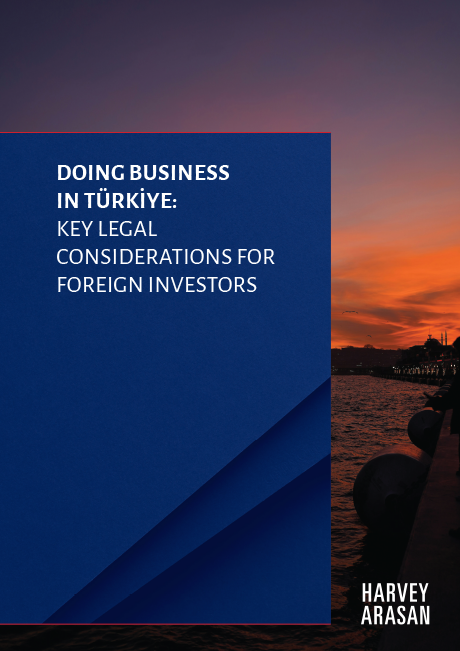
Harvey Arasan’s Doing Business in Türkiye guide provides foreign investors, international companies and their advisers with a practical introduction to the principal legal issues involved in establishing, acquiring and operating a business in Türkiye.
Who Is This Guide For?
The guide has been prepared for:
- Foreign companies considering entry into the Turkish market
- International groups planning to establish a subsidiary, branch or liaison office
- Investors evaluating the acquisition of, or investment in, a Turkish company
- Founders and executives establishing business operations in Türkiye
- In-house legal teams coordinating Turkish law matters
- Foreign law firms requiring a practical overview of the Turkish legal framework
It is intended to help decision-makers identify the legal questions that should be addressed before a proposed structure or transaction is finalised.
What Does the Guide Cover?
The guide examines five areas that commonly arise when foreign companies enter or operate in the Turkish market.
Corporate establishment and foreign investment
Foreign investors may generally establish and own companies in Türkiye under the same rules applicable to domestic investors, subject to certain sector-specific restrictions.
The guide explains the main market-entry options available to foreign investors:
- Joint stock companies
- Limited companies
- Turkish branches of foreign companies
- Liaison offices
It also outlines the incorporation process, corporate governance requirements, shareholder liability and the principal differences between these structures.
For further information, see our Corporate and Commercial Law services.
Employment and foreign personnel
Companies establishing operations in Türkiye should consider their employment structure at an early stage.
The guide provides an overview of employment contracts, probationary periods, working hours, annual leave, changes to working conditions and the termination of employment. It also introduces the principal work-permit requirements applicable to foreign nationals employed in Türkiye.
Intellectual property ownership
Protecting a company’s brand, technology and creative output require more than registration alone.
The guide considers trademark protection and the ownership of intellectual property created by employees or commissioned from third parties. Under Turkish law, paying for the development of a work does not necessarily result in the automatic transfer of all intellectual property rights.
Companies should therefore review their employment, development, consultancy and assignment agreements to ensure that the intended ownership and use rights are properly documented.
Further information is available on our Intellectual Property Law page.
Personal data protection
Businesses operating in Türkiye may be subject to the Turkish Personal Data Protection Law, commonly referred to as the KVKK.
The guide introduces the fundamental principles governing the processing of personal data, legal grounds for processing, special categories of personal data, registration with the Data Controllers’ Registry and international data transfers.
Foreign companies should assess their Turkish data-processing activities separately rather than assuming that GDPR documentation will automatically satisfy all requirements under Turkish law.
Our Turkish Data Protection Law and GDPR Advisory practice assists international businesses with data mapping, privacy documentation, data-processing agreements, international transfers and the operational implementation of compliance programmes.
Mergers and acquisitions
Foreign investors may enter the Turkish market by acquiring an existing business, purchasing shares in a Turkish company or establishing a strategic partnership with local shareholders.
The guide provides an introduction to:
- Share and asset acquisitions
- Principal transaction documents
- Foreign investment rules
- Sector-specific approval requirements
- Turkish merger-control considerations
- Competition Board clearance
The appropriate transaction structure will depend on the target company, the assets or rights being acquired, the regulated status of the business and the level of control obtained by the investor.
For transaction-specific information, see our Mergers and Acquisitions in Türkiye services.
Choosing the Appropriate Market-Entry Structure
There is no single structure suitable for every foreign investor.
A joint stock company may provide greater flexibility for investments, future share transfers and corporate governance arrangements. A limited company may be suitable for a more closely held operation but is subject to different transfer formalities and liability considerations.
A branch allows the foreign company to operate directly in Türkiye without incorporating a separate legal entity. A liaison office may be used for limited non-commercial activities, such as market research or representation, but cannot generate income in Türkiye.
The decision should be based on the investor’s proposed activities, ownership plans, financing structure, regulatory position, employment requirements and exit strategy.
Legal Support for Foreign Investors in Türkiye
Harvey Arasan advises foreign companies, investors, founders and international legal teams on establishing, acquiring and operating businesses in Türkiye.
Our work includes:
- Advising on the appropriate corporate and investment structure
- Incorporating Turkish companies and registering branches
- Preparing articles of association and shareholders’ agreements
- Drafting and negotiating commercial contracts
- Advising on employment matters
- Reviewing intellectual property ownership and contractual arrangements
- Supporting KVKK and international data-transfer compliance
- Conducting legal due diligence
- Advising on acquisitions, investments and joint ventures
- Coordinating Turkish law matters with foreign counsel and international transaction teams
Our lawyers work in Turkish, English and French and provide advice that takes account of both Turkish legal requirements and the commercial objectives of international clients.
Download the Guide
Download Doing Business in Türkiye: Key Legal Considerations for Foreign Investors for a practical overview of the Turkish legal framework applicable to market entry, company establishment, employment, intellectual property, data protection and M&A transactions.
If you are considering establishing, acquiring or operating a business in Türkiye, you may contact Harvey Arasan to discuss the legal requirements relevant to your proposed structure or transaction.
This publication and landing page have been prepared for general informational purposes only. They do not constitute legal advice or establish an attorney–client relationship. Legal requirements should be assessed in light of the specific facts and the legislation applicable at the relevant time.